
Executive Summary
AI is already entering onboarding.
Organisations are using or testing AI assistants for questions, personalised onboarding journeys, automated tasks, learning, feedback, manager support, and even assessment of whether a new employee is ready to work more independently.
But perhaps the most interesting question is not the obvious one.
- The usual question
How much of onboarding can we automate? - The more interesting question
What do we want people to do with the time AI gives back?
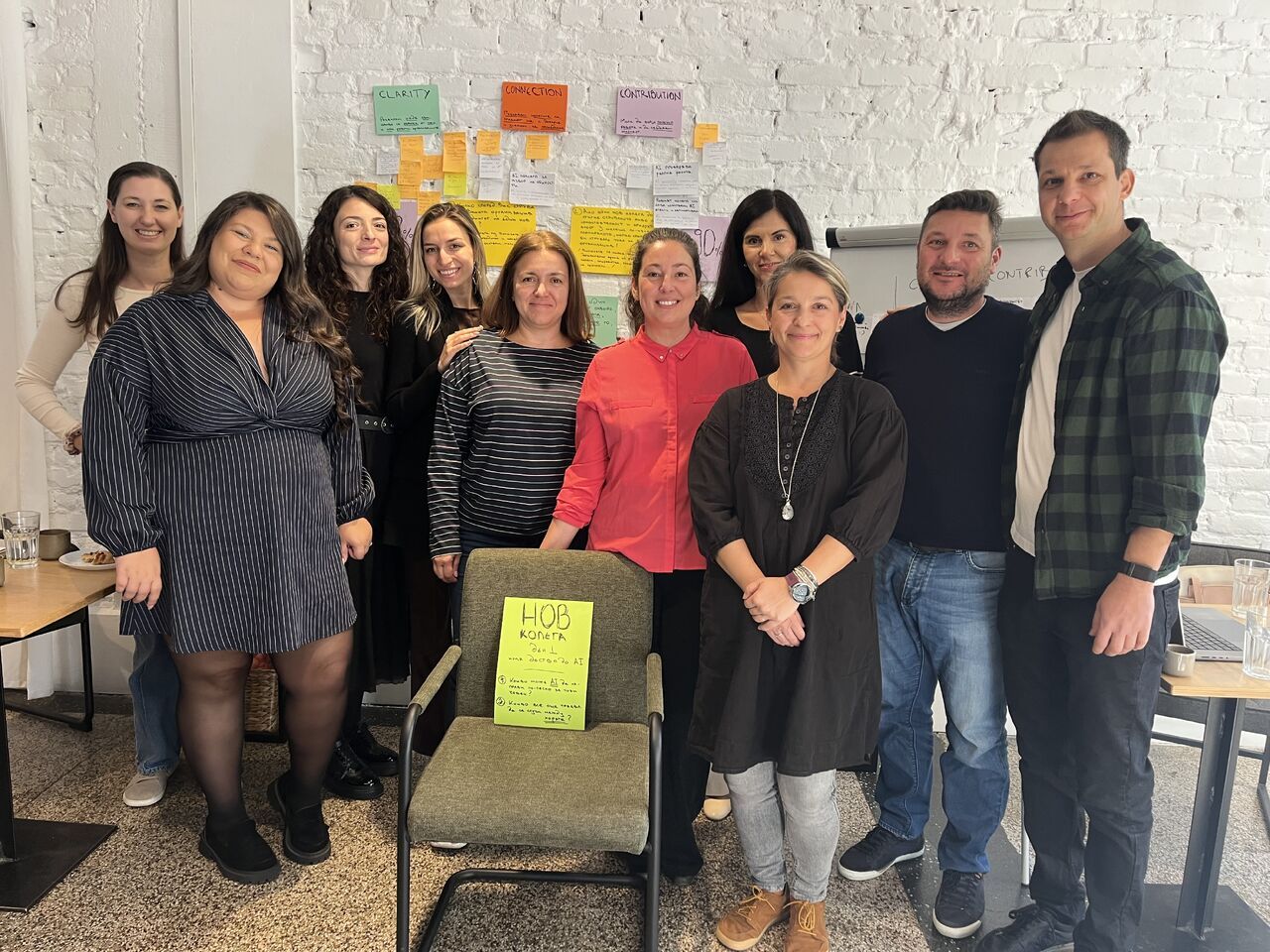
On 21 October 2026, eight practitioners from seven organisations and two hosts came together in Sofia to explore this question.
The conversation did not begin with technology. It began with more fundamental questions:
- What does successful onboarding actually look like?
- What does it cost?
- Who owns it?
- And how do we know whether it is working?
Only then did we turn to the role of AI.
Six main conclusions emerged from the discussion, combined with our review of research and international practice.
1Having an onboarding process does not mean knowing whether it works.
Every organisation represented in the discussion had a structured onboarding process. None described a structured approach to evaluating its overall effectiveness. This closely reflects earlier Bulgarian research by the Bulgarian Association for People Management:
- 72% of companies reported having a documented onboarding strategy
- ~90% lacked a process with concrete tools or indicators for evaluating its effectiveness
2Before improving onboarding, we may first need to agree on what success looks like.
Participants gave very different answers to the sentence, “Onboarding is successful when the new joiner can…” Their answers ranged from finding information and completing tasks independently to feeling confident, accepted and proud to be part of the organisation.
3Successful onboarding requires Clarity, Connection and Contribution.
A new joiner needs to understand the environment and expectations, build the relationships they need, and gradually begin creating real value. Academic research describes a remarkably similar picture, with role clarity, social acceptance and task mastery among the major proximal outcomes of organisational socialisation.
4Connection may need to start immediately. Clarity may increasingly arrive when it is needed.
Participants shared observations that new employees often remember who welcomed them and who they spoke to, while forgetting a significant amount of the information delivered intensively at the beginning. AI makes it possible for some of that information to appear later, in context and at the moment of real need.
5AI is moving from “answer me” to “act.”
In practice, we can already see a progression:
- Information retrieval
- Guidance
- Personalisation
- Action
- Assessment
- Dynamic adaptation of the onboarding journey
6The more AI can do, the more important the question becomes: what should remain human?
The strongest opportunity that emerged from the discussion was not removing people from onboarding.
The strongest opportunity:
Automate more of the process so we can humanise more of the experience.
1.Do We Know Whether Onboarding Works?
Before talking about AI, we asked participants to estimate two numbers. Seven of them gave approximate estimates.
| What we asked | Lowest estimates | Highest estimates | What participants counted |
|---|---|---|---|
| “How much does onboarding one new employee cost your organisation, excluding their salary?” | €2,000–2,500 | €12,000+ | The time of HR, the direct manager and colleagues, as well as training, systems, infrastructure, equipment and other resources |
| “If a new employee reaches the expected level of independence and productivity three months later than planned, how much would that cost the organisation?” | €3,000–5,000 | €40,000–50,000+ | Lost productivity, manager time, additional workload for colleagues, extra training, missed opportunities, underused assets and regulatory risks |
Everyone stressed that the figure depends heavily on the role and the organisation. The second question was significantly harder.
And that led to the more interesting finding.
None of the organisations represented systematically measured these costs in this way.
The measurement paradox
The discussion quickly moved in two opposing directions.
How do you improve something you do not measure?
Without indicators, it is difficult to know what works, what does not, and where further investment makes sense.
How much would the measurement itself cost?
Some onboarding costs are visible. Others are distributed across people, functions and systems. Some value appears indirectly through missed opportunities, risk, management time or the effect on the rest of the team.
Trying to calculate one “perfect” total cost may itself become too difficult and expensive.
So perhaps the more practical question is:
Which few indicators are reliable and useful enough to help us make better decisions?
Examples discussed in the room included:
- Time to expected productivity
- Time to expected independence
- Quality of output
- Errors
- Early attrition
- Time invested by the manager and team
Not measuring also has a cost
A broader hypothesis also emerged.
If a process is not measured, it is difficult to improve. If it is not improved, its value may gradually become less visible. And if the business cannot see the value, it may begin investing less time, attention and resources in it.
A possible negative cycle looks like this:
- 1We do not measure
- 2We do not improve
- 3We struggle to demonstrate value
- 4We invest less
- 5The process weakens
- 6Its value becomes even harder to demonstrate
↻ and the cycle starts again
The group raised the possibility that this may be one of the mechanisms through which onboarding gradually shrinks into a short administrative process in some organisations.
This also echoes earlier Bulgarian findings from Project ONBOARD: many organisations have a general sense of what onboarding costs them, while the return on that investment is more often assessed intuitively than through objectively collected and analysed data.
2.What Does “Successful Onboarding” Actually Mean?
Before presenting any framework, we asked each participant to complete the sentence independently:
“Onboarding is successful when the new joiner can…”
The answers included:
- …find the information they need independently
- …start completing tasks independently as quickly as possible
- …know who their manager is and who is in their team
- …know where resources are and how systems work
- …feel confident and accepted
- …feel comfortable asking questions
- …explain what the company does and what their role is
- …feel belonging and pride
- …make decisions and achieve results
All of these answers are reasonable. But they do not mean the same thing.
Clarity · Connection · Contribution
After the answers had already been written, we introduced three categories.
Clarity
I understand where I am, what is expected of me, and how work gets done here.
Connection
I know who to turn to, I can rely on the people around me, I can speak openly, and I feel part of the team.
Contribution
I can do useful work, handle unexpected situations, and improve the way we work.
When participants categorised their original answers:
- Clarity most answers fell around it
- Connection a significant number touched it
- Contribution was the least represented
The group is far too small for quantitative generalisation. But the observation raises a useful question:
When we think about onboarding, do we focus more on whether someone is oriented than on whether they are already able to contribute?
Research describes a remarkably similar picture
A 2025 meta-analysis by Bauer and colleagues, published in the Journal of Management and covering 256 studies of newcomer socialisation, identifies role clarity, social acceptance and task mastery among the major proximal outcomes of successful newcomer adjustment.
They are not identical to Clarity, Connection and Contribution. But the similarity matters.
| Our framework | In the research (Bauer et al., 2025) | What it is about |
|---|---|---|
| Clarity | Role clarity | Understanding |
| Connection | Social acceptance | Relationships |
| Contribution | Task mastery | The ability to do real work |
Successful onboarding is not simply an information problem. It is simultaneously about understanding, relationships and the ability to do real work.
3.Before Improving Onboarding, Do We Agree on What Success Looks Like?
At this point, the conversation reached a topic that had not originally been planned: alignment between the people involved in onboarding.
How would each of them answer the question about successful onboarding?
- HR
- The direct manager
- IT
- The team
- Learning and Development
- The new employee
Would they give the same answer?
If not, different people may design different activities, expect different outcomes and judge the same onboarding process using different criteria.
This may help explain a familiar organisational paradox. In the same organisation, some people say one thing, and others the opposite:
- “Our onboarding works extremely well.”
- “Our onboarding does not work at all.”
Perhaps they are simply using different definitions of success.
Participants concluded that the criteria should not be defined by HR alone.
The conversation needs to include everyone who materially shapes the onboarding experience: HR, direct managers, teams, IT, infrastructure and other functions depending on the role.
This changes the first step in improving onboarding.
- Not necessarily
What new activities should we add? - But
Do we agree on what the person should be able to do, understand and feel when onboarding is successful?
Without that agreement, the organisation may have decided what onboarding should achieve, while each function carries out its own version of it.
4.The Empty Chair: What Does the New Joiner Experience?
We placed an empty chair in the room. It remained empty throughout the meeting. The sign on it read:
NEW JOINER
DAY 1
HAS ACCESS TO AI
- What can AI make easier for this person?
- What still needs to happen between people?
Its purpose was to keep returning us to those two questions. This shifted the conversation:
- From
“What does the organisation provide?” - To
“What does the person actually experience?”
People stay in memory
Participants shared observations from internal studies and experience.
What new employees remember
- Who welcomed them
- Who they sat next to
- Who they spoke to
- How they felt
- How they were received
What can be forgotten relatively quickly
Much of the information presented intensively through slides and presentations.
We did not independently verify these observations and they should not be interpreted as a universal rule. But international research strongly supports the importance of social acceptance and relationships during newcomer adjustment.
From this emerged an important idea:
Connection immediately. Clarity when it becomes useful.
Traditional onboarding often attempts to provide as much information as possible, as early as possible:
- History
- Organisation
- Policies
- Values
- Products
- Systems
- Processes
- Benefits
But the new joiner does not necessarily need to remember all of it.
AI allows a different model. Information can remain available and appear in the right context exactly when the person needs it. Clarity can gradually shift:
- From
“Everything you need to know on Day 1” - To
“What you need to know right now.”
Two hours
This led to one of the most memorable examples in the discussion.
If AI can take over a large part of a two-hour HR presentation explaining the company, what could HR do with those two hours instead?
- Not
Two hours telling someone about the organisation. - But perhaps
Two hours helping them experience the organisation.
- Walk them around
- Introduce them to people
- Connect them with different teams
- Help them experience the culture
- Start building real relationships
And this led to a question that stayed with us for the rest of the conversation:
The question that stayed with us:
If AI takes over a task, what are we freeing human time for?
5.CLARITY: From More Information to the Right Clarity
Our preliminary Evidence & Practice Review separated Clarity into three different questions:
Context
Where am I and how does this place work?
Expectations
What is expected of me?
Process
How do I move forward from here?
The distinction matters. AI can give a clear answer to a specific question. But:
A clear answer does not necessarily create shared understanding.
What organisations in the room are already doing
Participants described a broad range of practices. The most widespread was an AI assistant for frequently asked HR and administrative questions. To varying degrees, all represented organisations were already using, testing or seriously considering such a capability.
- 80–90% fewer repetitive questions to one team after introducing such an assistant (an internal observation shared by a participant, not an independently verified result from this research)
Other practices included:
- Personalising information according to role, level, language and context
- Automated and personalised onboarding journeys
- AI onboarding assistants that guide the new employee, provide information and give feedback
- Personalised checklists and progress tracking
- AI embedded in internal HR systems to provide help during a specific task
- AI agents that move beyond explaining an administrative procedure and begin carrying out parts of it
- AI that dynamically adapts the next step based on the employee’s progress
Five additional practices worth watching
1Reconstructing the history behind decisions
A new employee does not enter an organisation at the beginning of its story. They arrive after years of decisions, changes and compromises.
In other words, a new joiner is asked to act on decisions they were not part of making. Understanding why those decisions were made is part of being ready to act on them.
AI can use documents, previous versions, meeting notes, email threads and other sources to help explain not only what the current decision is, but also how and why the organisation arrived there.
The limitation is obvious: a large part of real organisational context has never been documented.
2Supporting goals and expectations
AI can use the role, team priorities and organisational goals to help create concrete goals and first milestones. But there is an interesting risk.
Research by SAP involving 693 employees across six customer organisations found that AI-assisted goals were perceived as useful and motivating, but scored lower on alignment with company objectives.
A more clearly articulated expectation is not necessarily a more aligned expectation.
The same gap appears well beyond onboarding: a decision can be clearly written down and still be understood differently by the people who have to carry it out.
3Clarifying the roles of the human and the AI
As AI becomes part of everyday work, a new question enters onboarding: What am I expected to do myself, and what is acceptable to delegate to AI?
The new employee needs to understand not only their role, but also the boundary of acceptable delegation, review and accountability.
4Explaining what good performance looks like
Not only “This is the task.” But “This is what a good result looks like.”
AI can help make criteria, examples and expected quality more explicit. But defining what “good” ultimately means remains an organisational question, not a technological one.
5Detecting blockers and dependencies
An intelligent onboarding process can understand not only that a task is incomplete, but why:
- Access is missing
- Another team has not yet acted
- A previous step is incomplete
- The new employee is waiting for a decision
This moves automation from a checklist towards real process coordination.
The main risk with Clarity
AI can make information dramatically easier to access. It can reduce uncertainty, explain and personalise. But two people can receive a perfectly clear answer and still interpret it differently.
Therefore:
Clearer onboarding ≠ shared understanding.
6.CONNECTION: AI Can Open the Door, but People Build the Relationship
Connection is not one thing. Our preliminary review identified four distinct layers:
Relational access
Who can I turn to?
Relationship quality
Can I rely on these people?
Interpersonal safety
Can I ask, admit, disagree and be myself?
Social belonging
Am I accepted as part of us?
This creates another important distinction:
More connections ≠ more Connection.
What is already emerging in practice
One organisation in the discussion was testing conversational AI designed to support difficult conversations and situations, developed with input from psychologists. This example triggered a major debate:
- What can an employee safely share with a corporate AI?
- When should the system stop and refer the person to a human professional?
- Who is responsible for its recommendation?
- What information may be stored?
- What happens when the conversation moves beyond a professional context?
Participants and hosts also discussed using AI to suggest relevant internal communities, people and activities that could help a new employee integrate faster.
Five additional practices that may help
1Finding the right expert
An organisation chart shows roles. It does not always show who actually knows how to solve a particular problem.
AI can use skills, projects, documents and work history to identify people with relevant expertise.
But finding the right person only creates an opportunity for a relationship. It does not create the relationship itself.
2Better mentor or buddy matching
Instead of matching new employees and mentors only by function or availability, AI can consider goals, experience, interests and needs and recommend a better match.
The key design principle is that AI recommends, while a human retains the final decision.
3Suggesting a warm introduction
There is a difference between “Here is Maria’s email address.” and “Ivan already works with both of you and could introduce you.”
AI can use the existing social network of the organisation to suggest more natural ways for newcomers to reach the people they need.
4Supporting the manager and mentor
Connection is not only the new employee’s responsibility. AI can also support the other side of the relationship:
- Remind the manager about an unresolved question
- Suggest useful check-in questions
- Help prepare for a difficult conversation
- Support a more constructive response to a mistake, uncertainty or disagreement
5Supporting the first meaningful contribution to a community
Discovering a relevant internal community is one thing. Participating in it is another.
AI can summarise the previous discussion, suggest a useful question, or help the newcomer formulate their first contribution.
But there is an important boundary. If a newcomer asks a question and three colleagues reply, they receive more than information. They also receive social signals:
- We saw you.
- Your question belongs here.
- We are willing to help.
If the same question receives a perfect AI answer and the conversation ends there, Clarity may improve. Connection may not.
A useful principle from the review:
AI can help someone enter the room. The people in the room still determine whether they belong.
AI can remove the risk of a conversation. That does not make the environment psychologically safe.
There is also an important difference between two uses of AI.
- AI instead of a colleague
The employee asks AI instead of a colleague, and avoids the risk of appearing inexperienced or incompetent. - AI before the conversation
AI helps them prepare: formulate the question, rehearse the disagreement, structure difficult feedback. And then the human conversation still happens.
For Connection, that difference is fundamental. AI can eliminate interpersonal risk. Or it can help people take that risk more effectively.
Psychological safety is ultimately built by what happens when they do.
7.CONTRIBUTION: From Learning to Real Value
Eventually, onboarding needs to lead to work that creates value. We therefore look at Contribution through three different questions.
Proficient
Can I do useful work well?
Adaptive
Can I handle situations the playbook did not prepare me for?
Proactive
Can I improve the way the work gets done?
This leads to another important distinction:
More output ≠ more Contribution. Contribution exists when somebody can actually use the result.
What we discussed in the room
Practices already being used or considered included:
- Personalised learning
- AI assessing real or realistic work tasks
- Automated feedback
- Individual assessment that changes the next steps
- Support for managers in task setting, feedback and performance tracking
- Personalised development plans
- AI dynamically determining whether the person is ready for the next step
A broader idea also emerged: the newcomer should not only be a user of AI, but should learn during onboarding to use approved AI tools to automate parts of their own work. This makes AI literacy part of readiness for the role.
Five additional practices that may accelerate Contribution
1Assistance during real work
Not only training beforehand. AI can assist while the employee is doing the actual task:
- Retrieve context
- Suggest a first draft
- Analyse the situation
- Recommend a next step
Here we already have strong evidence:
- ~15% average productivity increase among 5,172 customer support agents after introducing a generative AI assistant, with larger benefits for less experienced and lower-performing workers
The study was not about onboarding. But it provides strong evidence that AI can help less experienced employees create useful output sooner.
2Predicting errors
Instead of only checking the final result, AI can intervene earlier: “There is a high risk of an error here.” or “People often overlook X in cases like this.”
This moves quality control into the work itself.
3Recognising when a human is needed
Perhaps one of the most valuable capabilities of AI is not always providing an answer. It may be recognising: “I am not sufficiently confident. This requires a more experienced person.”
This helps the newcomer learn not only how to solve problems, but also when they should not solve them alone.
4Comparing scenarios in ambiguous situations
When there is no obvious answer, AI can help explore different options, risks and consequences. This does not replace judgement. It prepares it.
An experiment involving 758 consultants illustrates why this matters. Across 18 realistic tasks inside AI’s capability frontier, people using AI completed more tasks, worked faster and produced higher-quality outputs. But on a task deliberately placed outside that frontier:
- 19% less likely to reach the correct answer when using AI
An experienced employee may recognise that a case is unusual because they have seen hundreds of normal ones. A newcomer does not yet have that pattern library. AI can compensate for some of that missing experience, but it can also produce a confident recommendation precisely when the new employee is least able to challenge it.
5Identifying and testing improvements
New employees have one special advantage: they have not yet become used to all the friction in the organisation. They notice things insiders may already accept as “just the way we work.”
AI can help them identify a recurring problem, formulate an idea, challenge it, compare alternatives, design a small experiment, and even build a prototype or automation.
This creates an important possibility:
Onboarding should not only teach people how we work. At some point, it should allow them to start asking how we could work better.
8.From Information to Decisions: The More AI Does, the More Important the Boundary Becomes
When we organised the practices, a clear progression appeared:
- Information
- Guidance
- Personalisation
- Action
- Assessment
- Dynamic adaptation
- Decision
The first steps are relatively easy to accept:
- AI finds a policy
- Reminds someone about a task
- Suggests content
- Explains a procedure
But once we reach questions such as these, the conversation changes:
- “Is this person ready?”
- “What should we do in this unusual situation?”
- “Should this affect their future development?”
- It is no longer enough to ask
“Can AI do it?” - We also need to ask
“Should we allow AI to do it autonomously?”
The group gradually identified a working boundary.
AI appears especially suitable for work that is
- Repetitive
- Predictable
- Clearly procedural
- Rule-based
- Easy to verify
- Easy to personalise using available data
The human role becomes especially important where we have
- Relationships
- Ambiguity
- Context
- Exceptions
- Conflicting values
- Judgement
- Accountability
But this is not a fixed line. The grey area between the two may be one of the most important organisational questions ahead.
9.Human-in-the-Loop Does Not Mean Simply Clicking “Approve”
The discussion around difficult situations naturally led to AI governance:
- Who is responsible for the advice?
- What is the system allowed to know?
- When must it hand the case to a person?
- Who defines the criteria used to assess performance?
- What happens when the result has real consequences for the employee?
This is no longer only a technology question. It becomes a question of organisational governance. And regulation is moving in the same direction.
The EU AI Act treats certain systems used in employment and worker-management contexts as high-risk. The rules for these high-risk applications include requirements around risk management, traceability, accuracy and appropriate human oversight.
- 2 Dec 2027 when the EU AI Act’s rules for high-risk applications are expected to begin applying
This does not mean every AI onboarding assistant is high-risk. But it demonstrates how important the distinction is between:
- AI assists
AI supports the people who decide. - AI decides
AI makes a consequential decision about a person.
10.What Happens When the Rule Does Not Work?
Towards the end, the conversation reached a deeper question. AI is very capable of identifying and using patterns. But real work is full of exceptions:
- The person does not react as expected
- Two good practices contradict each other
- The policy says one thing, but the context requires another
- There is not enough information
- The statistically “right” answer is not the right answer for this person
This led to a discussion about different sources of human judgement:
- Data
- Logic
- Experience
- Wisdom
- Intuition / instinct
Not as a scientifically proven hierarchy. But as a question:
Where does the usefulness of one end and the need for another begin?
A personal example from Stavros Stavru
When my first child was born, I approached parenting like an engineer. I read almost every book I could find. I was looking for the right algorithm.
A few months later, I was more confused than when I started. One book said one thing. The next recommended the opposite. My wife seemed far more capable of responding to the actual child and the actual situation.
Perhaps that was experience. Perhaps intuition. Perhaps something that is simply difficult to convert into a universal rule.
The same problem exists in organisations. A manager may have all the data, the policy, the best practice and the AI recommendation. And still need to say:
“Yes, but in this particular case we are going to do something different.”
Human-in-the-loop should not mean simply validating the machine’s decision. Sometimes the human is needed precisely because of:
- Context
- Judgement
- Wisdom
- Responsibility for the exception
One of the strongest questions from the session:
AI is very good at recognising patterns. But what happens when the right decision is precisely the exception to the pattern?
11.Three Questions for Every Onboarding Activity We Consider Giving to AI
The discussion suggests a simple practical framework.
1Can AI do this reliably?
- Is the task repetitive?
- Is it predictable?
- Are the rules clear?
- Do we have the necessary information?
- Can we easily verify the result?
If the answer is yes, there may be a strong opportunity for AI to take over part of the work.
2Should AI do it autonomously?
- What is the cost of an error?
- Is there sensitive human context?
- Is the decision reversible?
- Does it have real consequences for the person?
- Does it require judgement that the organisation does not want to delegate?
This determines the need for human oversight.
3What will people do with the time we save?
This may be the most important question. If AI saves one hour of administrative work for HR or a manager, what happens to that hour? More administration? Or:
- A meeting with the new employee
- A conversation about real work
- Introductions to colleagues
- Feedback
- Mentoring
- Observation
- Discussion of a difficult situation
- Building trust
The real value of automation is not simply the time saved.
It is what the organisation chooses to do with that time.
12.A Different Model for Onboarding
Traditional onboarding often looks approximately like this:
Information → Training → Onboarding complete
But “complete” is not the same as “ready”. The research and practitioner experience suggest a different picture. In an AI-enabled environment, we can think of onboarding as the simultaneous development of three capabilities.
Connection from the beginning
A real welcome. People you can turn to. Trust. Safety to ask. A growing sense of belonging.
Clarity when it becomes useful
The right information, in the right context, in the right language, for the specific role, at the moment it needs to be used.
Contribution through real practice
Real or realistic tasks. Feedback. Gradually increasing autonomy. Judgement when exceptions appear. Over time, the ability to improve the way work is done.
The three are not sequential stages. They develop together. AI simply changes the ways in which we can support them.
13.What Would We Measure?
If the goal is Clarity, Connection and Contribution, then “Did the employee complete all onboarding activities?” is not enough as a measure of success. An organisation could begin with questions such as:
Clarity
- Does the person understand their role and expectations?
- Do they know where to find the information they need?
- Do they understand how decisions are made?
- Do they understand how their work connects to organisational priorities?
Connection
- Do they know who to turn to?
- Do they have real working relationships?
- Can they safely ask a question or admit a mistake?
- Do they feel accepted as part of the team?
Contribution
- Can they perform the key tasks of their role?
- How much support do they still need?
- How do they handle unexpected situations?
- Can they make an appropriate decision when there is no obvious answer?
Business indicators
- How long does it take to reach expected productivity?
- How long does it take to reach expected autonomy?
- What is the quality of the work?
- What types of errors occur?
- How much time do the manager and team invest?
- Is there early attrition?
This is not intended as a universal scorecard. Quite the opposite. The question is for each organisation to decide:
For each organisation:
What does “ready” mean for us, and how would we know that the person has actually reached that point?
14.The Wider Context: HR Is Still Experimenting
The conversation in Sofia is not happening in isolation.
- 39% of organisations were already using AI in HR in 2026, with another 7% planning to adopt it within the year (SHRM)
- 56% of HR functions do not formally measure the success of their AI investments (SHRM)
- 19% of core HR processes in Europe were supported by generative AI in 2025, while another 32% were still in pilot mode (McKinsey)
Adoption is concentrated most heavily in recruitment, HR technology and Learning & Development.
- So the picture is not
“AI has already solved onboarding.” - It is closer to
Organisations are still discovering where AI creates real value, where it simply adds another layer of technology, and where it changes the nature of human work.
This is part of a larger question. Deloitte’s 2026 Global Human Capital Trends found:
- 6% of leaders believe their organisations are making meaningful progress in designing effective human-AI interactions
- 65% believe their organisational culture needs to change substantially because of AI
Technology is moving quickly. Organisational design is still catching up.
15.The Bigger Opportunity: Not Less Human Onboarding, but Better Use of Human Time
Towards the end of the session, the conversation gradually returned to where it began: to the new joiner. AI can make onboarding:
- Faster
- More personalised
- More accessible
- More consistent
- Less administratively demanding
But that does not automatically create a better experience.
- So perhaps the question is not
“How do we remove people from onboarding?” - It is
“How do we remove from people the things that do not require them to be human?”
Let AI do it
- If AI can find the right policy, let it.
- If it can remind someone about a task, let it.
- If it can translate, personalise and explain a procedure, let it.
- If it can help someone prepare for a difficult conversation, let it help.
- If it can catch an obvious mistake, let it flag it.
Use human time where it creates unique value
- In relationships
- In trust
- In sharing context
- In real conversation
- In feedback
- In judgement
- In exceptions
- In belonging
- In taking responsibility
Conclusion
- At the beginning of the conversation, we asked
What happens to onboarding when AI is available from Day 1? - By the end, the question had changed
Not “AI or humans?”, but: Where is AI genuinely useful, and where should it hand the baton back to a person?
We did not find a universal boundary. There probably is not one. But a consistent principle emerged.
AI is increasingly capable of taking over what is repetitive, predictable, procedural and information-heavy. It can find, explain, personalise, remind, coordinate, check, and increasingly, act.
That does not make the human side of onboarding less important. It may make it more visible. Because once part of the administrative noise is removed, the harder questions remain:
- Does the person understand why we are here?
- Do they know how work really gets done?
- Do they have people they can rely on?
- Can they ask when they do not know?
- Do they feel part of this place?
- Can they create real value?
- Can they recognise when the situation requires something more than the rule?
- Can they eventually move beyond working well within the system to helping make the system better?
That may be the biggest opportunity for onboarding in the AI era:
Automate more of the process so we can humanise more of the experience.
Questions That Remain Open
- When does onboarding actually begin, and when does it end?
- Who should define the criteria for successful onboarding?
- How much of the cost and impact is practical to measure?
- How do we know when someone has reached the expected level of autonomy?
- Can AI determine when someone is ready?
- When must an AI recommendation be reviewed by a human?
- Which decisions should never be delegated, regardless of technical capability?
- Can AI support Connection without replacing the interactions through which Connection is built?
- How does the role of the manager change when AI can take over part of the guidance and feedback?
- What happens when established best practice does not fit the individual case?
- How do organisations build AI literacy during onboarding itself?
And most importantly:
How do we know whether onboarding is actually helping the person and the organisation succeed together?
About This Report
This report combines four types of input.
1Practitioner roundtable
A closed, facilitated discussion held on 21 October 2026 in Sofia with eight practitioners from seven organisations and two hosts.
2Organisational practices
Examples of AI practices that participants are already using, testing or considering.
3Three preliminary Evidence & Practice Reviews
Clarity, Connection and Contribution, prepared before the session using academic research, organisational examples and emerging AI practices. The Clarity review examines context, expectations and process; the Connection review, relational access, relationship quality, interpersonal safety and social belonging; the Contribution review, proficient, adaptive and proactive contribution.
4Additional international validation
Academic research, current international HR studies and documented organisational practices.
The roundtable is not a representative study of Bulgarian employers. The numbers and observations from the discussion should not be interpreted as population-level estimates.
The purpose is different: to identify
- Recurring themes
- Tensions
- Differences in perspective
- Emerging practices
- Questions organisations can test in their own context
Acknowledgements
This report would not exist without the openness and practical experience of the participants in Onboarding in the AI Era:
 Ivelina SlavovaIngram Micro
 Emil MinevExtreme Consulting
 Yoana StaykovaCobuilder
 Zlatka KraychevaCobuilder
 Reni KrasimirovaIntermedica
 Daria TopalovaPlaytech
 Elitsa PetrovaSAP
 Veronika TsvetanovaCoca-Cola
Thank you for bringing not only good practices into the room, but also the questions, doubts and areas where none of us yet has a complete answer.
The session was created and facilitated by Vesela Koleva, Ph.D. and Stavros Stavru, Ph.D.
The report was written by:
 Vesela Koleva, Ph.D.Author · Host
 Stavros Stavru, Ph.D.Author · Host
 Ivan MitovAuthor
ExecuteOS supported the session (see About ExecuteOS below).
About ExecuteOS
ExecuteOS supported this session. The findings in this report come from the participants and the research cited, not from ExecuteOS.
ExecuteOS tells a leadership team whether the people who have to execute its next priority actually understand it, believe in it and know how to act on it, then runs the sessions that close the gaps before execution starts. Onboarding is one of the priorities it is used for.
Where ExecuteOS fits
Two findings in this report describe the problem ExecuteOS works on:
A clear answer is not shared understanding
AI can give every new joiner a clear answer. But two people can receive a perfectly clear answer and still interpret it differently.
Few organisations know whether onboarding works
Every organisation represented in the discussion had a structured onboarding process. None described a structured approach to evaluating its overall effectiveness.
The report ends on a question each organisation has to answer for itself: what does “ready” mean for us, and how would we know that the person has actually reached that point? ExecuteOS helps with the second half. It shows whether new joiners share the same understanding of the business, the culture and the ways of working, and where they do not, before the gaps show up in their work.
How: conversation, not presentation
- Listening
New joiners receive the information: a welcome deck, presentations, documents, an AI assistant that answers their questions. - Conversing
New joiners work through it together with their peers: each shares how they understand it, they compare, and they agree what it means for their work.
This is also where Connection is built. Understanding the company becomes something new joiners build together, not something they absorb alone, and along the way they gain:
- Real relationships with their peers from the first weeks
- A community of new hires who keep supporting each other after onboarding
- A sense of belonging and identity from the very beginning
This report’s framework and ExecuteOS
| ExecuteOS shows | The question | Closest idea in this report |
|---|---|---|
| Shared knowledge | Do they understand the business, the culture and the ways of working in the same way? | Clarity |
| Conviction | Do they believe in it and mean it? | Connection, through belonging and pride |
| Practice | Can they act on it in a real situation? | Contribution |
An example onboarding program
Every organisation builds its own program around its needs, its existing onboarding process and the topics it already covers. As a starting point, ExecuteOS offers a template of four one-hour sessions in which new joiners work through the company together:
1Know the business
How we make money, who our customers are and how we got here.
2Live the values
What the values mean in real decisions, and where people doubt them.
3Know who is who
Who decides what, who to ask and how to reach them.
4Work the way we work
The everyday rules for meetings, decisions, feedback and asking for help.
AI frees up the time. ExecuteOS turns it into shared understanding and Connection.
See the onboarding template · Find out if your team is ready: free, about 3 minutes, no sign-up
Selected Sources
Bauer, T. N., Erdogan, B., Ellis, A. M., Truxillo, D. M., Brady, G. M., & Bodner, T. (2025). New Horizons for Newcomer Organizational Socialization: A Review, Meta-Analysis, and Future Research Directions. Journal of Management, 51(1), 344–382.
Brynjolfsson, E., Li, D., & Raymond, L. R. (2025). Generative AI at Work. The Quarterly Journal of Economics, 140(2), 889–942.
Dell’Acqua, F. et al. (2026). Navigating the Jagged Technological Frontier: Field Experimental Evidence of the Effects of Artificial Intelligence on Knowledge Worker Productivity and Quality. Organization Science.
Bulgarian Association for People Management. Project ONBOARD. Research on onboarding practices among 107 HR professionals.
SHRM (2026). The State of AI in HR 2026.
McKinsey & Company (2025). HR Monitor 2025.
Deloitte (2026). Global Human Capital Trends 2026.
European Commission. EU AI Act and implementation guidance for high-risk AI systems.
Additional organisational examples and emerging practices were reviewed in the three Evidence & Practice Reviews on Clarity, Connection and Contribution prepared in October 2026.